


Hawaiian Service Organizations
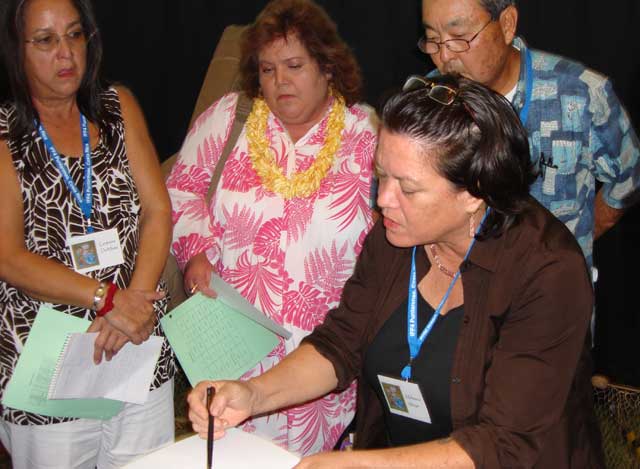
ʻAha Pūnana Leo
Hawaiian Royal Societies (ʻAha Hīpuʻu)
Alu Like
Association of Hawaiian Civic Clubs
Bishop Museum
Council for Native Hawaiian Advancement
King William Charles Lunalilo Trust and Home
Native Hawaiian Education Council
Native Hawaiian Roll Commission
Papa Ola Lōkahi
Sovereign Councils of the Hawaiian Homelands Assembly
ʻAha Pūnana Leo
ʻAha Pūnana Leo was founded in 1984 by a group of Hawaiian language educators who established the first Hawaiian immersion school in Kekaha, Kauaʻi. Today, a complete preschool through doctoral-level system of education in the state of Hawaiʻi is taught entirely through Hawaiian.
Hawaiian Royal Societies (ʻAha Hīpuʻu)
The royal societies share a common principle and purpose — to further the welfare of the Hawaiian people with important measures and projects.The Royal Order of Kamehameha was established by Kamehameha V in 1865, and ʻAhahui Kaʻahumanu was founded by his sister, Victoria Kamamalu in 1863. The Daughters and Sons of Hawaiian Warriors—Māmakakaua—was to follow in 1912, and Hale O Nā Aliʻi O Hawaiʻi opened in 1918.
Alu Like
Established in 1975, ALU LIKE, Inc. provides services including community economic development, business assistance, employment preparation, training, library services, educational and childcare services for families with young children, with locations on all islands.
Association of Hawaiian Civic Clubs
The Association of Hawaiian Civic Clubs (AHCC) is the oldest Hawaiian community-based grass roots organization founded in 1918 by Prince Kūhiō Kalanaianaʻole. The 58 clubs are located throughout Hawaiʻi and in nine states. AHCC advocates for improved welfare of native Hawaiians in culture, health, economic development, education, social welfare, and nationhood, and to perpetuate and preserve language, history, music, dance and other cultural traditions.
Bishop Museum
Bishop Museum was founded in 1889 by Charles Reed Bishop in honor of his late wife, Princess Bernice Pauahi Bishop, the last descendant of the royal Kamehameha family. The Museum houses the extensive collection of Hawaiian artifacts and royal family heirlooms of the Princess, and has expanded to include millions of artifacts, documents and photographs about Hawaiʻi and other Pacific island cultures.
Council for Native Hawaiian Advancement
CNHA is a national, member-based nonprofit organization focused primarily on Native communities in Hawaiʻi and the Pacific. Its mission is to enhance the well-being of Hawaiʻi through the cultural, economic, and community development of Native Hawaiians. The organization provides a strong voice on public policy, operates a community loan fund, delivers capacity building and leadership development services, and promotes community-owned enterprises.
King William Charles Lunalilo Trust and Home
Lunalilo Home was established by the will of High Chief William Charles Lunalilo, who died in 1874 while he was king of the Hawaiian Islands. The purpose of the trust was to build a home to accommodate the poor, destitute, and infirm people of Hawaiian (aboriginal) blood or extraction, with preference given to older people. Today, Lunalilo Home also provides Adult Day Care, Respite, and home meal deliveries.
Native Hawaiian Education Council
The Education Council was created in 1984 under the terms of the Native Hawaiian Education Act and is responsible for assessing, coordinating, reporting and making recommendations on the status of Native Hawaiian education.
Native Hawaiian Roll Commission
The Native Hawaiian Roll Commission was signed into law in 2011 in order to create a list or roll of Hawaiians who wish to convene together to create a Native Hawaiian nation. Funded by OHA, in 2012 the Commission launched its effort, called Kanaʻiolowalu, to sign up all eligible Hawaiians and their non-Hawaiian supporters.
Papa Ola Lōkahi
Papa Ola Lōkahi is a clearinghouse for data and timely information associated with the health status of Native Hawaiians. Its mission is to improve the health status and well-being of Native Hawaiians and others by advocating for, initiating and maintaining culturally appropriate strategic actions aimed at improving the physical, mental and spiritual health of Native Hawaiians and their ʻohana (families) and empowering them to determine their own destinies.
Sovereign Councils of the Hawaiian Homelands Assembly
The SCHHA’s purpose is to provide a unified opportunity to educate, govern and insure its efforts to protect, preserve and defend the Hawaiian Homes Commission Act of 1920 as amended by advocating, empowering beneficiaries, and increasing capacity of new members to advance in self governance and self determination.